What is this calculator for?
It helps you mix concrete on site in the right proportion. Choose the strength you need (f'c in kg/cm², psi or MPa), enter the dimensions of the member and it tells you how many bags of cement, how many m³ of sand and gravel and how many liters of water to buy.
It also turns the mix into what is used on site: how many buckets, cans, boxes, wheelbarrows or shovels of sand, gravel and water go with each bag of cement, so every batch is mixed the same way.
How to use it
- Enter the length, width and thickness (or height) of the member. For a 0.30 × 0.30 m column 2.50 m high, enter 0.30, 0.30 and 250 cm.
- Choose the strength. As a guide: 140 kg/cm² for ground slabs and sidewalks, 175–210 kg/cm² for house slabs, beams and columns, and 100 kg/cm² or less for blinding and fill.
- Choose your country: it sets the cement bag weight (42.5 kg in Peru, 50 kg in Bolivia) and reference prices. Replace the prices with your local ones.
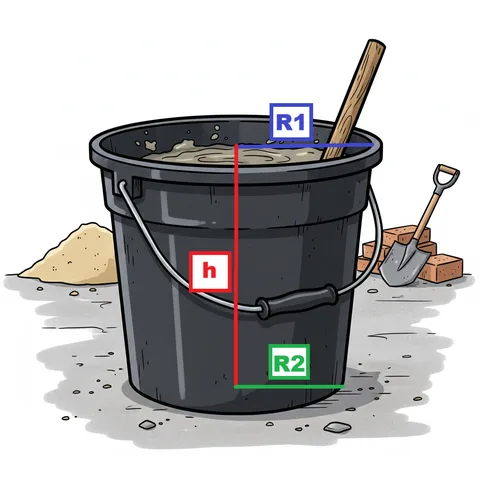
- Choose what you measure with on site (bucket, box, wheelbarrow or shovel) and its size. If your bucket is different, measure it and the tool works out its capacity.
Formulas used
Each strength has an amount of cement, sand, gravel and water per m³ of concrete, taken from commonly used mix tables. They are multiplied by the volume including waste.
Volume = Length × Width × Thickness × (1 + Waste / 100)
Cement (bags) = Volume × Cement per m³ ÷ Bag weight → rounded up
Sand = Volume × Sand per m³ Gravel = Volume × Gravel per m³
Water = Volume × Water per m³
Sand per bag (L) = Sand per m³ × 1000 ÷ (Cement per m³ ÷ Bag weight)
Containers per bag = Liters per bag ÷ Container capacity
Worked example
A 5 × 4 m slab 10 cm thick is 2 m³; with 5 % waste it is 2.10 m³. For f'c 210 kg/cm² (1 : 2 : 3.5) each m³ takes 320 kg of cement, 0.52 m³ of sand, 0.90 m³ of gravel and 170 L of water.
In total: 672 kg of cement (16 bags of 42.5 kg or 14 of 50 kg), 1.09 m³ of sand, 1.89 m³ of gravel and 357 L of water. Each 42.5 kg bag takes 69 L of sand (3.5 buckets of 20 L), 120 L of gravel (6 buckets) and 23 L of water.
Tips for good concrete
- Water affects strength the most: don't add extra water to make it flow. If the sand is wet, use less water.
- Use clean sand and gravel, free of soil and roots. Gravel should not exceed one third of the slab thickness.
- Dry-mix cement and sand first, then the gravel and finally the water little by little until the mix is even.
- Cure the concrete: keep it moist for at least 7 days. Without curing it loses much of its strength.
- For columns, beams and multi-story slabs, ask for a mix design with your aggregates and cylinder tests.
Frequently asked questions
How many bags of cement in one m³ of f'c 210 concrete?
About 320 kg: 7.5 bags of 42.5 kg or 6.4 bags of 50 kg, plus 0.52 m³ of sand, 0.90 m³ of gravel and 170 L of water.
Which mix should I use for a house slab?
The usual choice is f'c 210 kg/cm² (3000 psi). Ground slabs and sidewalks need 140 kg/cm²; blinding and fill, 100 kg/cm² or less.
Can I measure with buckets instead of m³?
Yes. Choose the bucket, can, box or wheelbarrow in "How to measure it on site" and the tool tells you how many go with each bag of cement.
Does this table guarantee the strength?
No. These are reference quantities for site-mixed concrete. Actual strength depends on the sand and gravel, the water and the curing. Important structures need a mix design and cylinder tests.
How do I convert kg/cm² to psi or MPa?
1 kg/cm² is about 14.2 psi and 0.098 MPa. For example, 210 kg/cm² is about 3000 psi or 20 MPa. The strength list shows all three units.
Free today. Pro, coming soon
Calculating and quoting will stay free. Pro will be for people who quote every week.
I want to be a founder